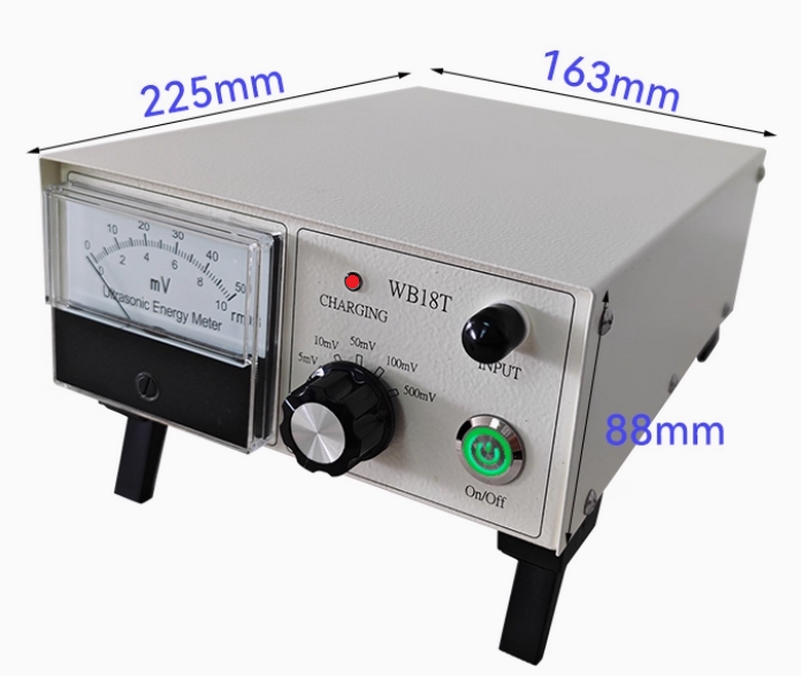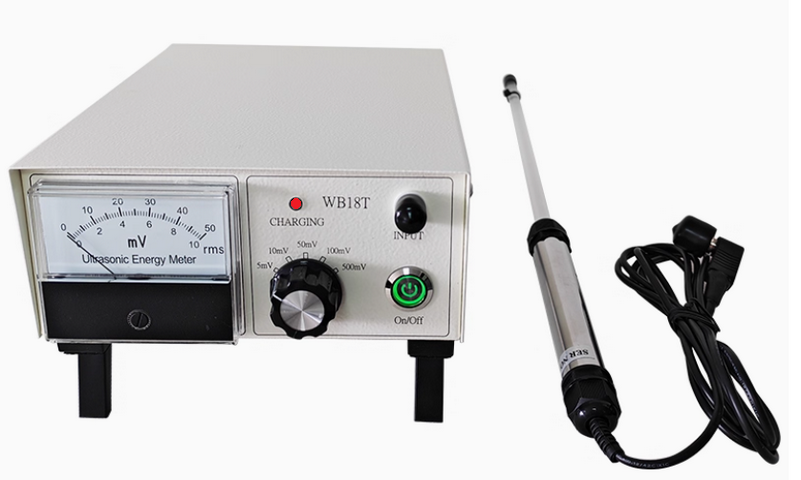
WB18T 超音波音壓計特點:
Digitizing ultrasonic underwater power output.
Portable measurement method.
No external power source needed on-site.
Ultra-low power consumption.
12-hour battery life on a full charge.
Verify on-site ultrasonic underwater power output with full digitization.
Broad Range: Supports 3K to 300KHz measurement.
Efficiency Checks: Validates ultrasonic cleaner performance.
Uniformity Testing: Monitors power consistency across multiple points in the tank.
Reliability: Superior performance with a 2-year warranty.
Portability: Built-in rechargeable battery for mobile use.
Product Specifications
Model: WB18T
Dimensions: 225 x 163 x 88 mm
Voltage: AC 90–240V (Universal Voltage)
Frequency Range: 3 kHz – 300 kHz
Power Consumption: Under 10W
Included Accessories:
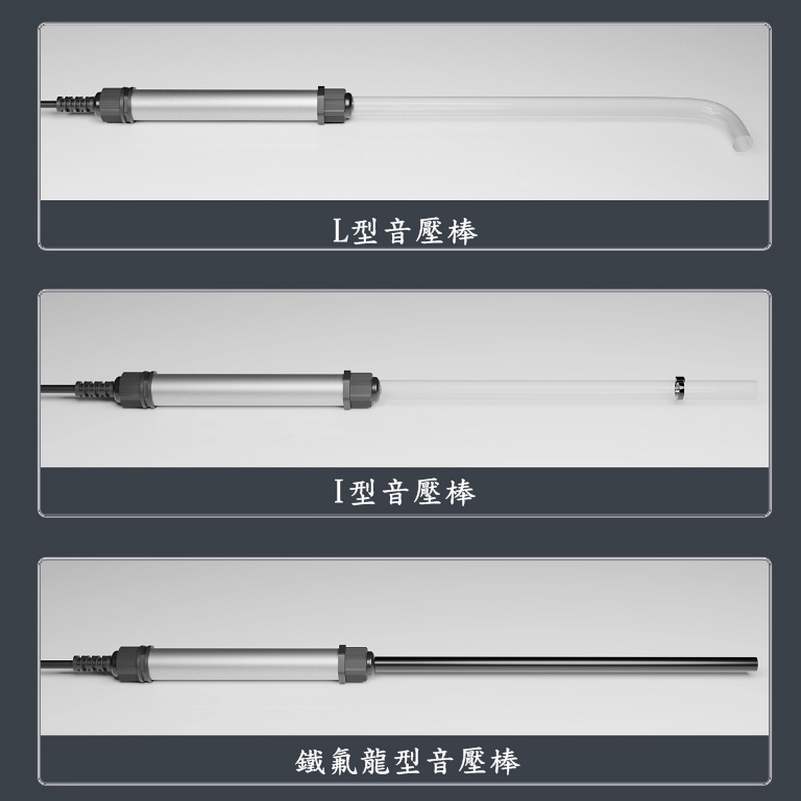
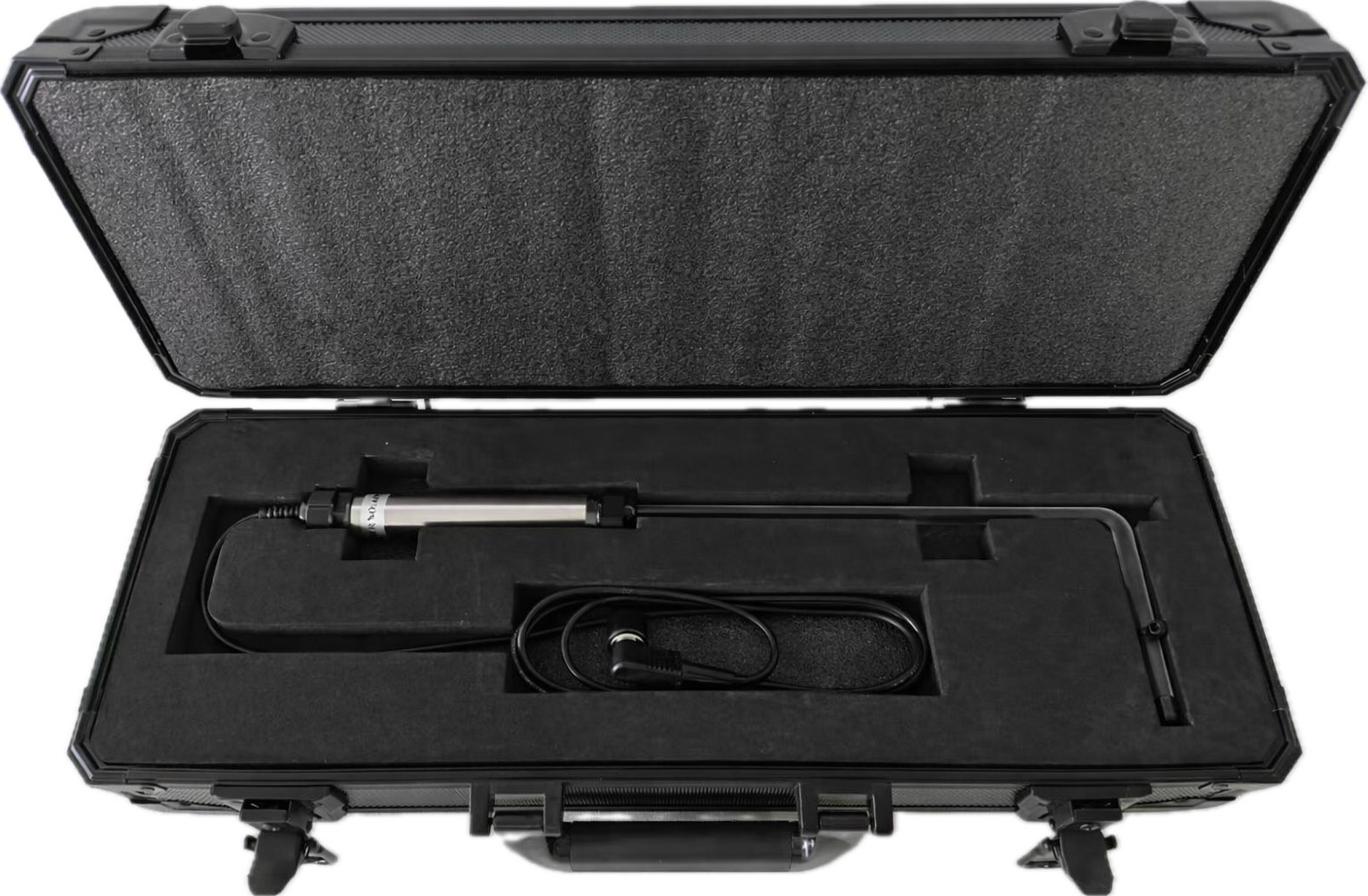
Ultrasonic probe (Sound pressure probe)
Dedicated carrying case
Power cord
Technical Specifications & Safety Note
Frequency Range: 3 kHz – 300 kHz
Measurement Sensitivity: 5 precision ranges available (5, 10, 50, 100, 500 mV).
⚠️ Critical Note: If the liquid being measured is Hydrofluoric Acid (HF), the Teflon-coated model must be purchased.
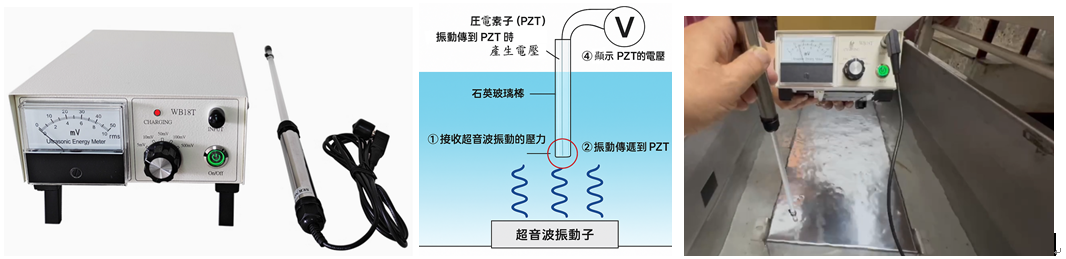
頻率觀測方法
28KHz 音壓量測及清洗效果
棒式清洗機 - 音壓測試
20KHz 音壓量測及清洗效果
40KHz 音壓量測及清洗效果
鐵氟龍音壓計展示
FAQ: Ultrasonic Power & Measurement
Q1: Is a measurement of 15mV considered "pass" or "qualified"?
A1: Since every ultrasonic machine varies in frequency and power, the sound pressure value primarily reflects the current baseline of your specific unit.
If cleaning performance is satisfactory at 15mV, it can be considered qualified for your process.
If cleaning results are poor, we recommend discussing the data with the equipment manufacturer to check for potential hardware issues.
Q2: Does a higher frequency lead to a higher sound pressure reading?
A2: Yes. Higher frequencies have shorter wavelengths, resulting in a higher "impact frequency" against the probe. This increased accumulation of energy typically leads to a higher measured sound pressure value.
Q3: How deep and where should I place the probe for the best results?
A3:
Location: The center of the tank is usually the most stable zone. We recommend measuring at the geometric center for consistency.
Depth: An immersion depth of 30–100mm is ideal. Crucial: Always maintain the exact same depth for every measurement to ensure data accuracy.
Angle: Tilting the probe at approximately 10 degrees while submerged can further improve measurement stability.
Q4: Why is the green light on the panel flashing?
A4: This indicates that the built-in battery is low. It is time to recharge the device.
Q5: Why isn't the measured sound pressure always proportional to the machine's power consumption?
A5: Sound pressure is influenced by multiple environmental variables, not just output power.
Case 1: Tank Material Matters
Scenario: A 28KHz/1800W unit in a Stainless Steel tank reads 22mV. The same unit in a PP (Plastic) tank reads only 10mV.
Reason: Stainless steel reflects ultrasonic waves efficiently, keeping energy in the water. PP absorbs and dampens the waves, lowering the reading.
Case 2: Load Interference (Baskets & Parts)
Scenario: Adding a cleaning basket and products can cause a reading to drop from 22mV to 15mV.
Reason: The basket and workpieces absorb and "split" the ultrasonic energy, naturally reducing the sound pressure in the liquid.
Case 3: Frequency Shifts
Scenario: Switching from 28KHz to 40KHz (keeping power and material the same) might increase the reading to 28mV.
Reason: Higher frequency means more impacts per second, which often registers as higher sound pressure.
Summary: Sound pressure readings depend on a combination of tank material, loading (baskets/parts), frequency, and tank resonance. For the same machine, changing any environmental factor will change the measurement results.